THCA vs THC
THCA vs THC: Understanding the Differences, Effects, and Risks
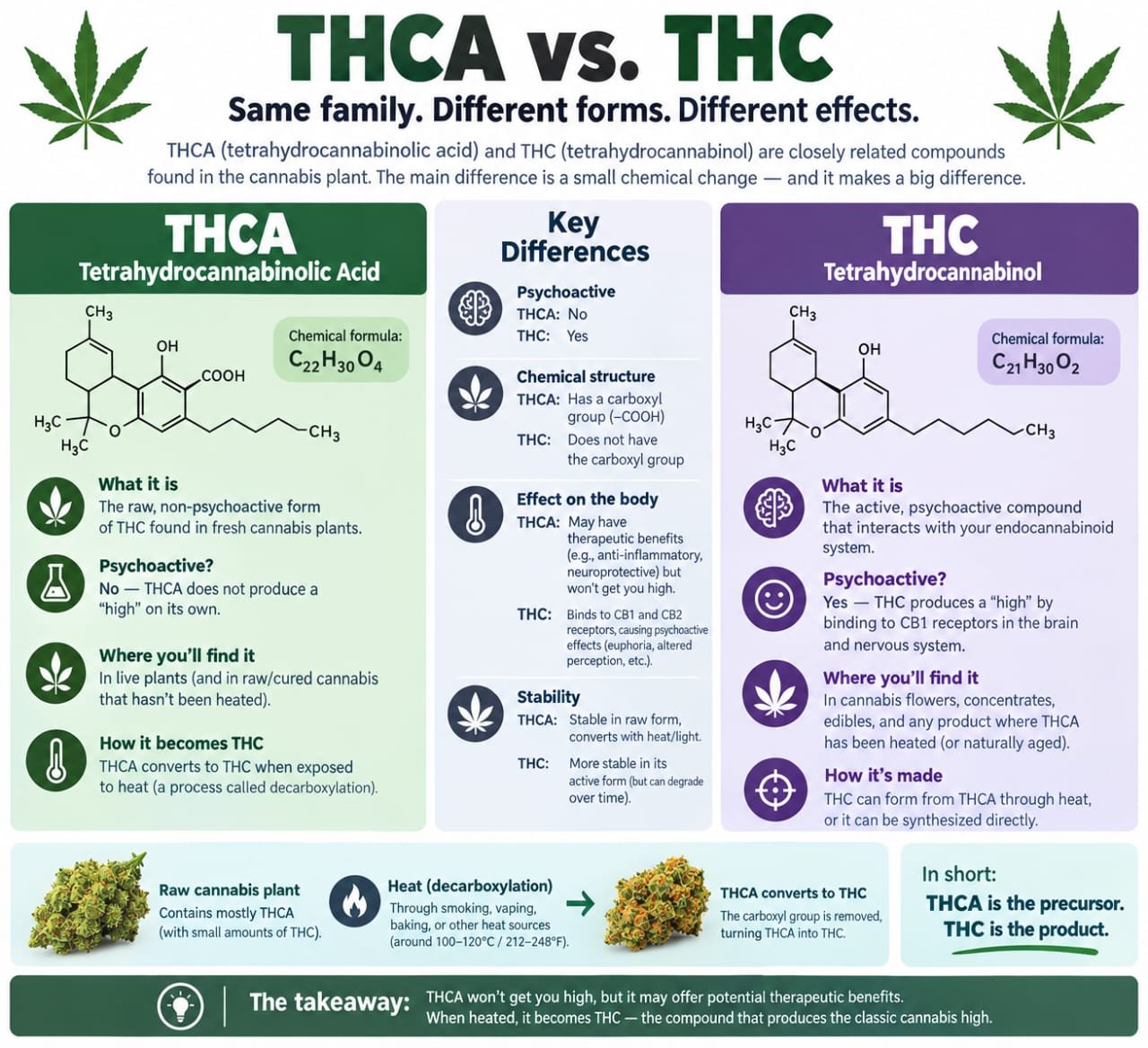
THCA and THC are closely related cannabis compounds, but they are not identical. THCA, short for tetrahydrocannabinolic acid, is an acidic precursor to THC. In its unheated form, THCA generally does not produce the characteristic cannabis high. THC, or tetrahydrocannabinol, is the intoxicating compound associated with changes in perception, mood, memory, and coordination.
The connection between them is decarboxylation, a chemical reaction that converts THCA into THC. Heating cannabis through smoking, vaping, or cooking can trigger this conversion. Consequently, a product advertised as rich in THCA may still produce substantial intoxication when heated. Understanding this relationship helps explain cannabis labels, potency claims, and why “low THC” does not always mean low intoxicating potential.
What Is THCA?
THCA stands for tetrahydrocannabinolic acid. It is a cannabinoid found in cannabis and the precursor associated with delta-9 THC. Cannabinoids are compounds that interact with biological systems, although their effects differ significantly from one another.
In fresh or unheated cannabis, much of the potential THC content exists as THCA rather than already converted THC. This makes THCA important when evaluating flower and other products intended for heating.
Calling THCA a precursor does not mean it is biologically inactive. Researchers have investigated its potential effects, but its pharmacology and therapeutic value remain incompletely understood. It should therefore be distinguished both from intoxicating THC and from a proven medical treatment.
What Is THC?
THC usually refers to delta-9-tetrahydrocannabinol, the main intoxicating compound associated with cannabis. It can produce relaxation, euphoria, altered time perception, and increased appetite. It can also cause anxiety, impaired judgment, and difficulties with attention or coordination.
Unlike THCA in its unheated form, THC produces the familiar cannabis high. Its effects vary according to the amount consumed, product strength, method of consumption, and individual factors.
THC has also been studied for medical applications, including certain forms of pain, muscle spasticity, and chemotherapy-related nausea. However, evidence for a specific treatment does not establish that every THC-containing retail product is effective or suitable for the same purpose.
The Main Difference Between THCA and THC
The central difference is chemical structure. THCA contains a carboxyl group that THC does not. During decarboxylation, that group is released as carbon dioxide, leaving THC behind.
This structural difference helps explain why the compounds do not produce identical effects. THCA does not ordinarily cause the characteristic intoxication associated with THC, while THC can significantly affect perception and performance.
Their relationship also means they cannot be evaluated in isolation from product use. A flower containing substantial THCA may have relatively little already formed THC on its laboratory report. Nevertheless, heating that flower can convert its THCA into THC and create an intoxicating experience.
How Does THCA Become THC?
THCA becomes THC through decarboxylation. Heat promotes this chemical reaction, which is why smoking, vaping, and preparing heated cannabis foods can change a product’s cannabinoid composition.
The process is more than a marketing description of cannabis becoming “activated.” It involves a measurable chemical transformation. The resulting THC molecule has less mass than the original THCA molecule because carbon dioxide has been lost.
Real-world conversion is not necessarily complete. Heating conditions, product characteristics, and chemical degradation can influence the outcome. For that reason, a calculation of potential THC should not be interpreted as the exact amount that reaches a person’s bloodstream or produces effects.
Does THCA Get You High?
Unheated THCA generally does not produce the typical THC high. However, this answer requires an important distinction between the isolated compound and the finished product.
A product labeled THCA may also contain some THC. More importantly, if the product is smoked or vaped, its THCA can convert into THC. Someone using high-THCA flower in this way should not expect a nonintoxicating experience simply because the packaging emphasizes THCA.
The practical question is therefore not only “What compound is listed?” but also “How will this product be used?” The same starting material can have a different intoxicating potential after heating.
Why THCA Flower Can Be Intoxicating
THCA flower is often marketed by highlighting its acidic cannabinoid content. Chemically, however, the conversion relationship remains the same: heating can turn that THCA into THC.
This explains why a laboratory report showing little delta-9 THC can coexist with a product capable of producing a strong high. The report may be describing the flower before heating, rather than its potential after conversion.
A low number for already formed THC should therefore not be considered reassuring on its own. For products intended to be smoked or vaped, THCA content is directly relevant to potential intoxication. Ignoring it creates an incomplete picture of strength.
Understanding Total THC
“Total THC” is an estimate that combines already present THC with the THC potentially produced from THCA. A commonly used calculation is:
\text{Total THC}=\text{delta-9 THC}+(0.877\times\text{THCA})The factor of 0.877 accounts for the difference in molecular mass after THCA loses carbon dioxide. Simply adding the THCA and THC percentages without this adjustment would overstate the theoretical THC mass.
This calculation describes potential content, not a guaranteed delivered dose. It assumes conversion for the purpose of estimation, while actual heating and consumption introduce losses and variability. Total THC is useful for interpreting potency, but it cannot precisely predict an individual experience.
How to Read a THCA Laboratory Report
A certificate of analysis, often shortened to COA, may list THCA, delta-9 THC, and calculated total THC separately. These numbers answer different questions and should not be treated as interchangeable.
When reviewing a report, distinguish:
- THCA already present in the tested material.
- Delta-9 THC already present before heating.
- Total THC estimated from both measurements.
- The particular sample or batch associated with the results.
The most important interpretive step is recognizing whether a number describes existing THC or potential THC after conversion. A report dominated by THCA can still describe flower with considerable intoxicating potential. Laboratory results should be read alongside the intended consumption method.
Is THCA Stronger Than THC?
Asking whether THCA is stronger than THC can be misleading because “strength” may refer to different things. Unheated THCA does not produce the same characteristic intoxication as THC, so comparing them as though they were equivalent intoxicants is inappropriate.
When discussing heated flower, the relevant question becomes how much THC the product could produce. A high THCA percentage may indicate substantial potential THC, but that does not make THCA inherently more intoxicating than THC.
Product concentration also does not fully predict the experience. The amount used, delivery method, previous exposure, and other factors affect the outcome. A single percentage cannot capture all these variables.
THCA vs. THC in Edibles
The distinction matters in edible products because preparation can change the cannabinoids present. Heating THCA-containing material may convert some or much of it into THC before consumption.
A finished edible should therefore be evaluated according to its actual composition, not merely the identity of the starting ingredient. A product made using THCA-rich material may contain intoxicating THC after processing.
This also illustrates why product names can be insufficient. Consumers need clear information about the finished formulation and cannabinoid amounts. A claim that an edible began with THCA does not establish that it remains nonintoxicating or that its effects will be mild and predictable.
Does THCA Have Medical Benefits?
Researchers have investigated THCA for possible anti-inflammatory, neuroprotective, and other biological effects. These findings are scientifically interesting, but much of the evidence comes from laboratory experiments and animal studies.
Such research does not establish that a commercial THCA product treats inflammation, protects the human brain, or improves a particular disease. Human clinical evidence remains limited, and important questions about effective dosing, safety, and interactions are unresolved.
The distinction between potential and proven benefit is essential. THCA should not be presented as an established treatment simply because preliminary studies identify promising activity. Claims require evidence relevant to the condition, formulation, and patient population.
What Medical Uses Does THC Have?
THC has a more developed clinical evidence base than THCA. Research supports benefits in certain contexts, including some chronic pain conditions, muscle spasticity, and chemotherapy-related nausea and vomiting.
However, the evidence varies by condition and preparation. Studies of defined cannabinoid medicines do not automatically validate every cannabis flower, concentrate, or edible sold with a similar claim.
Medical use also involves weighing benefit against adverse effects. Intoxication, cognitive changes, and other risks may limit suitability for particular patients. The existence of therapeutic applications should not be interpreted as evidence that THC is universally appropriate or that stronger products produce better medical outcomes.
Are THCA Products Safer Than THC Products?
THCA should not automatically be described as safer. Its lack of characteristic intoxication in an unheated form addresses one issue, but it does not establish comprehensive safety.
Human research on THCA remains insufficient to define its long-term risks, optimal dosing, or interactions confidently. Finished products also vary in composition, and heating can introduce the effects associated with THC.
A more accurate comparison considers the entire exposure: the cannabinoids present, the intended delivery method, additional ingredients, and the person using the product. “Nonintoxicating before heating” is a narrower statement than “safe,” and the two should not be confused.
What Risks Matter After Conversion to THC?
Once a THCA product produces THC through heating, THC-related risks become relevant. These include changes in judgment, memory, coordination, and emotional state.
Some people experience anxiety or panic rather than relaxation. Others may underestimate impairment because the effects feel familiar or enjoyable. Enjoyment does not establish that attention and reaction time remain normal.
Repeated cannabis exposure can also create longer-term concerns, including problematic use. A product’s THCA branding does not remove these considerations when its practical use delivers THC. The biological effects depend on what is ultimately consumed, not solely on the name used to market the starting material.
THCA vs. THC vs. CBD
THCA, THC, and CBD are distinct cannabinoids, even though all are associated with cannabis. THCA is the acidic precursor to THC. THC produces the characteristic intoxicating high. CBD does not produce that same high.
THCA and CBD should not be treated as equivalent simply because neither ordinarily produces THC-like intoxication in its isolated, unheated form. Their chemical properties, evidence bases, and potential applications differ.
Likewise, a product containing several cannabinoids may behave differently from an isolated compound. Reading the complete formulation is more informative than placing everything into a single category such as “nonintoxicating cannabis.” Product composition and use determine which distinctions matter most.
Is THCA Legal Wherever THC Is Restricted?
THCA legality cannot be answered reliably without identifying the jurisdiction and applicable rules. Laws may distinguish between delta-9 THC already present and total THC calculated using THCA, while product categories can be regulated differently.
This makes broad advertising claims such as “legal everywhere” unreliable. A seller’s description does not establish that possession, shipment, or use is permitted in a particular location.
The scientific and legal questions should also remain separate. A product’s classification under a regulation does not change its ability to generate THC when heated. Legal availability, where it exists, is not proof of nonintoxicating effects or medical safety.
Common Misconceptions About THCA and THC
Several misunderstandings repeatedly complicate the comparison:
- “THCA cannot cause a high.” Heating a THCA-rich product can produce intoxicating THC.
- “Low delta-9 THC means weak flower.” THCA may contribute substantial potential THC.
- “THCA is a proven treatment.” Strong human clinical evidence remains limited.
- “Total THC predicts the exact experience.” It estimates potential content, not individual effects.
- “A hemp label guarantees safety.” Product terminology does not establish composition or risk.
These misconceptions share a common problem: they focus on one label while ignoring chemistry, preparation, and evidence. Evaluating the full context produces a more accurate understanding.
Understanding the Difference Beyond the Label
THCA and THC are different compounds connected by a chemical transformation. THCA generally does not produce the characteristic cannabis high before conversion, while THC does. Heating makes their relationship especially important for interpreting flower, concentrates, and prepared products.
The clearest comparison considers chemical form, potential THC content, consumption method, and the quality of supporting evidence. THCA’s emerging research should not be overstated, and its branding should not obscure the effects of THC generated during use.
Ultimately, understanding THCA vs. THC means looking past a single percentage or marketing term. The relevant question is what the product contains, what processing changes, and what effects the resulting exposure may produce.